
So, you want to be a HazMat Medic? PART 2
Armando S. Bevelacqua,
We started this column with a general overview of what a hazmat medic is all about. We approached the question of, “What is a hazmat medic?” in the most general terms. In this article, I would like to give some details about the roles and responsibilities a medical provider may have at the HazMat event. But before we dive into this, let me clear up one significant point and that is training and the training levels.
Although a HazMat Medic as a certified medic and HazMat Technician as the preferred level of education, an EMT with Hazmat Technician working under the guidance of the hazmat medic is perfectly acceptable. But what about the third service agency that only provides EMS level response and no or limited Hazmat training, but they are called to the HazMat scene so that the Incident Commander can check off that box! These folks are fully capable of providing care to the hazmat team if, and only if, they are properly trained. A third service paramedic should have HazMat Technician or, at the minimum, Operations mission specific so they understand the hazmat complications.
A third service EMT or Paramedic can have the level of training that would complete the true task of medical support at the incident. However, the local system would like to organize their service is up to the authority having jurisdiction. Training along with the proper personnel supplied with an acceptable level of equipment is a must. Train your personnel to what level you expect them to perform and give them all the tools so they can perform that level of service. I know it sounds simple and it is, but there are so many agencies that fail in either equipment provided, not enough training or worse yet not enough people to perform the task.
- Post Entry and Heat Stress – I am going to identify this one specifically as this area is become a significant health and safety concern. Evaluation of your personnel is vital in relation to potential heat stress issues. We see after fires, extended extrications, Technical Rescues and HazMat are all incident types that can produce a heat emergency. We also see that responders have a higher tendency towards heart attacks, during these dehydration states. Rehabilitation, the most important job at any emergency scene also comes with a heavy medical component to it which for the most part is being missed and ignored. Cooling the responder, immersion baths, cooling tents along with pre-entry hydration all can have a positive influence at the scene of a hazmat event.
- Post Entry and Heat Stress – I am going to identify this one specifically as this area is become a significant health and safety concern. Evaluation of your personnel is vital in relation to potential heat stress issues. We see after fires, extended extrications, Technical Rescues and HazMat are all incident types that can produce a heat emergency. We also see that responders have a higher tendency towards heart attacks, during these dehydration states. Rehabilitation, the most important job at any emergency scene also comes with a heavy medical component to it which for the most part is being missed and ignored. Cooling the responder, immersion baths, cooling tents along with pre-entry hydration all can have a positive influence at the scene of a hazmat event.
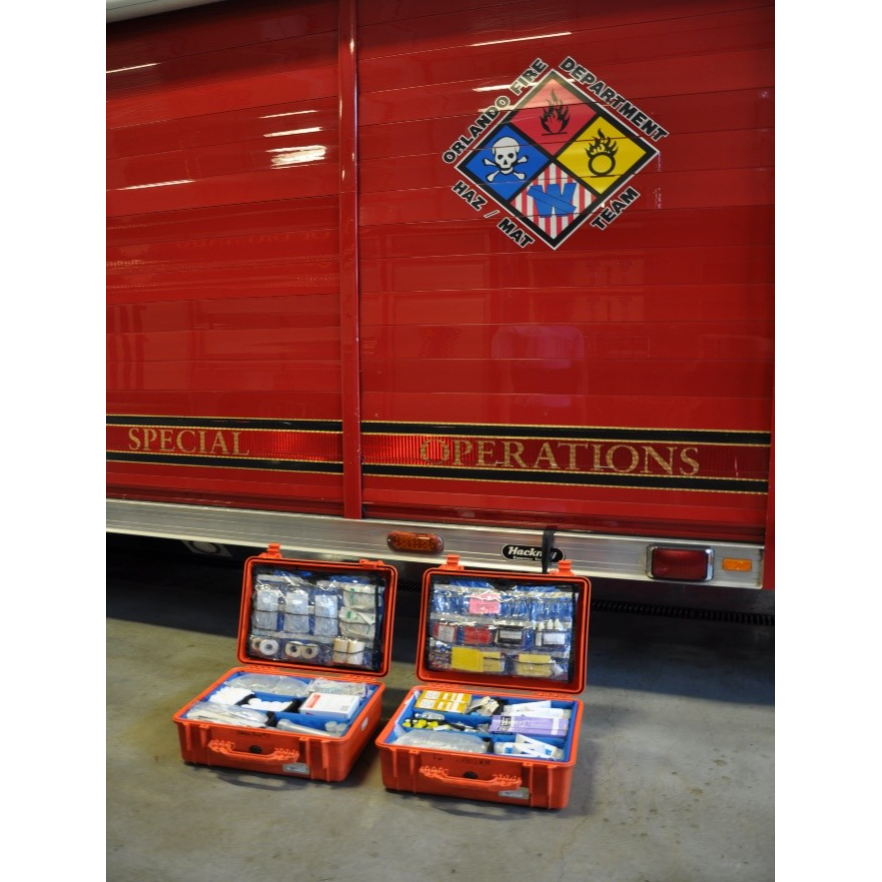
What is the list of responsibilities and what are the roles of the HazMat Medic?
- Research – Looking up the chemical and physical properties and the associated toxicology to formulate a medical plan of action. Just like the Incident Commander has the responsibility to generate an Incident Action Plan, it is the medical practitioner at the hazmat event that should generate a Medical Action Plan. If an exposure has occurred and no plan; you’re behind the eight ball.
- Anticipation of medical needs – This is an analysis of the scene to see what level of potential exposures you have or could you have in the immediate future. Can you provide the level of medical care and what tools do you have or are needed to accomplish the role of patient care, i.e. enough antidotes.
- Pre/post entry physicals – There is an argument out there in the hazmat arena that pre-entry physicals are not needed. One can argue that because you have a medical fit for duty physical once/twice a year or every other year. This would accomplish the pre-entry physical, and at face value you have a good argument. However, it is not entirely justified. The pre-entry is not just a gathering of vitals (which so many responders focus on that) but rather the person as a whole. My example is that a responder has just been trained as a HazMat Technician and this is his/her first real job, his vitals are going to be all over the board. But you know the responder and you know that this is due to nerves. Second is the fact that it is a OSHA requirement and to be honest it is just prudent to medically evaluate your personal at all emergency scenes.
- Post Entry and Heat Stress – I am going to identify this one specifically as this area is become a significant health and safety concern. Evaluation of your personnel is vital in relation to potential heat stress issues. We see after fires, extended extrications, Technical Rescues and HazMat are all incident types that can produce a heat emergency. We also see that responders have a higher tendency towards heart attacks, during these dehydration states. Rehabilitation, the most important job at any emergency scene also comes with a heavy medical component to it which for the most part is being missed and ignored. Cooling the responder, immersion baths, cooling tents along with pre-entry hydration all can have a positive influence at the scene of a hazmat event.
- Treatment – This is the one area that most focus on and to be frank it is the least actually used. But treatment comes in several forms. It may be as subtle as evaluation after event such as in the rehabilitation section, or as aggressive as giving an individual antidotal medication.
- PTSD and Peer support – Just like any area of emergency work we see bad things. Things that most people think they understand but they really do not. If you have been a responder for any length of time you have memories, some good some bad. And it is these bad events that over time will accumulate and have an effect on you. My analogy is that you start in the emergency services with this ball of emotional twine, and as you go through your career you give that emotional twine away. Until one day you look inside and see that once large ball of emotional twine seems so much smaller, you continue until you now know that the ball is so small you need all of it for yourself. And that is where Peer Support comes in. Responders that have been where you are at understand and can help with that emotional ball of twine. They can help repair to a certain level what is needed to maintain and continue in the emergency services and in life in general.
- Medical advocate – Medics that are specially trained in this field are not your average medic. They gravitate towards helping under a variety of conditions. This responder not only assists at the scene of the emergency but also assists at the receiving facility. They have strong communication with the emergency department and more than likely have worked within the ED. They have proven themselves in the eyes of the emergency department staff. They then can assist in the medical plan of an injured responder, forming a liaison between the agency and the hospital.
This list is the basis for the responsibilities of a Hazmat Medic. It is the short list. As started before it all depends on the level of service you plan to provide. However, this list is the minimum required level of service for hazmat medicine.


The Only Way to Win
Hazards of Carbon Dioxide Dewar Containers in Fast Food-Type Occupancies
Hazmat Academy
About The Author
